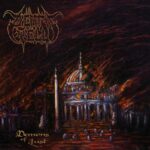
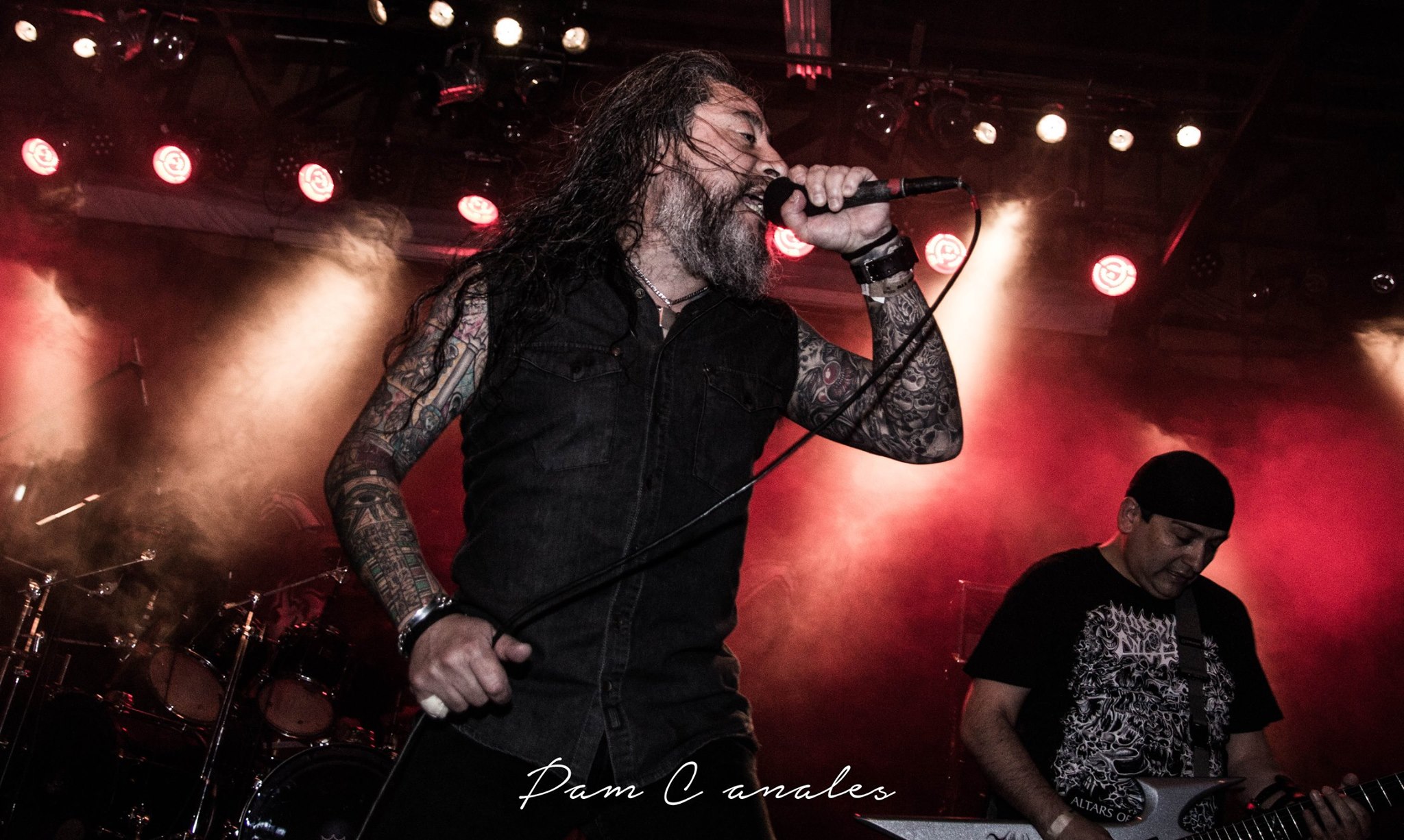

Although we Europeans initially remembered Death Yell primarily as “that other band” on the split 7″ EP with Beherit, these Chileans were of great importance in the development of Extreme Metal in South America at the end of the 1980s. Of course, thoughts easily turn to Sepultura or Sarcófago, but beneath those icons there was another layer of underground heroes such as Atomic Aggressor, Impurity, Mutilator, Vulcano, Masacre, Mortem, and… Death Yell. Personally, I was very happy with the 2007 double LP ‘Morbid Rites’ (Nuclear War Now! Productions), a compilation of all the band’s old recordings, which until then were either unavailable or very difficult to obtain. Looking back, the release of this compilation seems to have been the catalyst for Death Yell’s second youth. I spoke with guitarist and founding member Andrés “Pollo” Lozano about the new album, ‘Demons Of Lust’ (Hells Headbangers Records), and as an amateur music historian, I obviously also wanted to talk about the band’s early days.

Hi Andrés, first of all I’d like to thank you for doing this interview with me. With Death Yell being a major influence on my personal taste in music I see this as an honor. Before we take a deeper dive into your new album, ‘Demons Of Lust’ and the current state of the band, I’d like to go back into the earliest steps of the band. Now that we are here with this second album in our hands, released at the end of 2025, it is a good moment to realize that the band has now been around three times as long as the famous first period in which you delivered your cult releases. Is that something you ever think about?
Not at all. We don’t measure Death Yell in years or periods. Time outside the band doesn’t count. What matters is intent. The first era was short because it had to be — it was never planned or predetermined. This one is longer simply because we want it to be. That’s it. No plans, no charts. We move as we feel.
Within the South American scene in general and more specifically the one from your native Chile, Death Yell was a very influential band back around the late 80’s and early 90’s with the early demos. In Europe the band is mostly known for the split 7” EP with Beherit and in the USA due to the Seraphic Decay released ‘Morbid Rites’ 7” EP. How do you generally look back on this first period of the band? And what do you think about the musical legacy of those early releases? Do you think they were indeed as influential as is often claimed?
We look back on that period as something raw, honest, and unfiltered. No strategy, no career thinking, no audience in mind — just aggression, darkness, and conviction. Those releases were made without any special intention other than pushing our own boundaries. Were they influential? That’s not for us to decide. We didn’t try to influence anyone. We just recorded what we were living. If people found something real in it, good. If not, that’s fine too. “Legacy” is something other people talk about when they need labels.
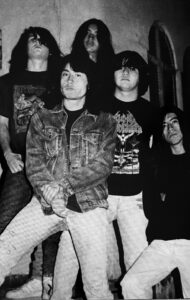
Now that you’ve reached roughly the halfway point of your life, you probably often think back to the past, like almost everyone else. How did you experience those years in the early Chilean metal scene of the late 80s and early 90s? And how do you experience that scene now, so many years later? What are the biggest differences for you, both nationally and internationally?
Back then it was about friendship and brotherhood, but it was also hostile, poor, and isolated — especially in Chile — and that’s exactly why it was real. There was no scene tourism. You either belonged or you didn’t.
Today everything is more visible, more connected, more immediate. That has advantages, but also dilution. There are more bands, more releases, more noise, more comfort — and less necessity.
In general, how would you describe the Chilean metal scene today? To an outsider like me, who has never set foot on Chilean soil, it seems like an (extreme) metal paradise. In the last twenty years or so, it seems as if every Chilean plays in a metal band… How do you experience that as an active participant and one of the instigators of your country’s metal scene?
It’s strong, no doubt about that. There’s an insane amount of bands and activity. But quantity doesn’t necessarily equal intensity. Chile has always had extreme metal in its blood — that hasn’t changed, and we keep hearing that from bands visiting us.
What has changed – maybe – is the reason why people do it. We come from a time when metal was an escape and a weapon. I guess not everyone plays for that reason anymore. Still, what matters is that there are many good bands across all styles and subgenres — old school and modern, analog and digital. We’re happy to be part of this era, just as much as we were part of the ’80s.
In 2007, Nuclear War Now! Productions released the fantastic double LP ‘Morbid Rites’, finally giving me the opportunity to get hold of all the old Death Yell material I had been hunting for so long and only had on dubbed cassette tapes. How did you experience this renewed interest in the band? Did you ever expect Death Yell to receive attention again, so many years after the band broke up?
Honestly, it surprised us. We never expected Death Yell to resurface like that. For us, those recordings were buried chapters. Seeing people hunt them down, care about them, and treat them with respect made us realize that maybe Death Yell wasn’t finished yet. But it wasn’t just nostalgia — it felt like unfinished business. That’s what re-ignited the flame and eventually led us to where we are now, presenting our second LP… 36 years later.
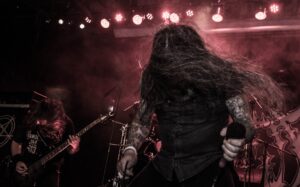
I have always believed, perhaps out of a somewhat romanticized view of the situation, that the release of the ‘Morbid Rites’ double LP planted the seed for Death Yell’s eventual return in 2012. Was that the case? Or should we look elsewhere for the reasons behind it? If I am to believe the annals, the band finally got together in 2012, the first sign of life came in the form of a split 7” EP with Atomic Aggressor in 2013 via Hells Headbangers, followed three years later by a second 7” EP, this time with Morbosatan. Looking back on these two releases now, are you satisfied with the choices you made to return in this way? There were a lot of eyes (ears) focused on you…
It certainly helped and was an important element in the decision to come back in 2012, but it wasn’t the only reason. There was also something internal. We felt we needed to do this again properly, without compromise. As mentioned before, it was an unfinished chapter for all of us.
We broke up abruptly in the ’90s without a real, agreed-upon reason — we just stopped. In a way, we restarted the same way. The splits were a way to test the ground, not to announce anything. Looking back, they were the right move. No full return, no hype — just signals, starting with our first new song, “Back from the Depths.”
On your return, the band consisted almost entirely of the original members. That in itself is quite remarkable; it’s not often that virtually everyone still has the same interest in extreme metal after so many years, but I can imagine that it was important in the process of coming back. How was the chemistry after all those years, and was it indeed very important to do this together again?
It was very natural, because nothing was forced. If the chemistry hadn’t been there, Death Yell would probably have stayed dead. Doing it together again was essential for all of us.
We even tried to incorporate Pato, our original drummer, but logistics made it almost impossible. We didn’t want to be a digital or studio-only band — we wanted to rehearse again in a small, hot, fetid room. Otherwise it would’ve just been another band using an old name, almost like a tribute band.
In 2016 original guitarist Pulga left the band and you have switched drummers a couple of times too. Line-up changes always affect the relationships and the vibe within a band, how do you look back at these changes in personnel?
Line-up changes are part of reality. People leave as priorities change — there’s no drama in that. We’re still good friends with every former member.
Pulga leaving, as a founding member, could have been painful, but it wasn’t. Watiu was already there — as he liked to say, “qualified for the position” — and Chato was an old friend from earlier times who had played with Galleta in different projects. We were able to stand up quickly.
It’s true that with drummers we haven’t been as lucky, but we’re very happy now with Lucuma. Time has shown that Death Yell is bigger than any single member, but smaller than its core idea. As long as that remains intact, the band survives.
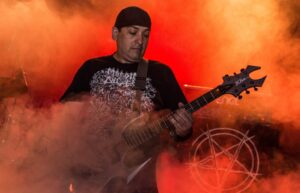
Speaking of which, more on a musical side though, before writing a review of ‘Demons Of Lust’, I listened to ‘Descent Into Hell’ again, as well as the older demo recordings. And what struck me most was how consistent Death Yell’s style is. The musical difference between ‘Vengeance From Darkness’ from 1989 and this latest work from 2025 is truly negligible. Not only in the song structures, but also in the intensity of the music and even the overall production, something I would call truly unique. How do you explain this musical stubbornness, if I may call it that?
Because we never really evolved — and we never thought about doing so. Evolution is overrated. We found our language early and never felt the need to consciously update it.
Of course there’s natural change: we’re not the same youngsters anymore, almost 40 years of experience makes a difference, and technology is different too. Still, even considering all that, it’s the same riffs, the same violence, the same intent. If that’s stubbornness, then yes — we’re stubborn. Proudly.
The band was officially formed in 1987 under the name Pestilence, but it took until 2017 for your debut LP to be released. Does ‘Descent Into Hell’ encompass everything you expected and wanted to achieve with your first album? If you put yourself back in the moment in 1989 when you recorded the music for your first demo tape, could you have imagined that 28 years later you would release your first full-length album?
Yes. It’s very close to the album we could have released decades earlier. No reinterpretation, no modern vision — just Death Yell as it always was. In 1989 we couldn’t imagine releasing a full-length 28 years later, but we also couldn’t imagine surviving that long. Life does strange things.
After the release of ‘Descent Into Hell’ it took you another eight years to come up with your second effort, this newly released ‘Demons Of Lust’. Is it fair to conclude that Death Yell is not a band that rushes into things, but rather takes its time and makes well-considered decisions?
Yes and no. We don’t work with deadlines, and we don’t rush things — but we also don’t make carefully calculated decisions. We work with necessity and willingness. We work as we feel. If there’s nothing to say, we stay silent. That’s always been our way.
Something different, in the time Death Yell was dead and buried, you have briefly had a Heavy Metal band called Raptor with which you released one album in 2009. How did you end up in this band, something quite different from Death Yell, and how do you look back at this period?
Raptor was completely different, and that was the point. Rock and heavy metal, straightforward, no dark ritual. It was a project with good friends — a break, really — just hanging out with no other purpose. No regrets. It was never Death Yell, and it was never meant to be.
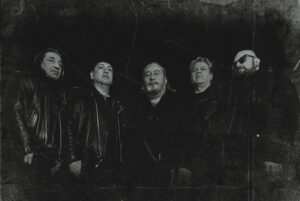
Especially in the last couple of years lots of South American bands made the trip to Europe for rather extensive touring. At this side of the world we’ve been able to enjoy bands like Anal Vomit, Masacre, Impurity, Goat Semen and Mortem on our stages. Are there any plans for Death Yell to do something alike?
Nothing concrete. We’re not chasing tours. If it happens under the right conditions, fine. If not, Death Yell doesn’t lose sleep over it. Even if it’s tempting, we don’t exist to travel — we exist to play and enjoy. If touring includes those two elements, then yes, we’ll be there sooner or later.
Alright Andrés, thank you so much for your time and effort. It’s up to you to wrap up this interview with your last words…
Thanks for your words, for the interview, and for the opportunity to make us better known through your zine. Maybe just to say this: Death Yell was never about revival, trends, or validation. It’s about staying true to something rough, violent, and honest. Demons Of Lust is not a comeback record — it’s a natural step in what we were, what we are, and what we will be.
Those who understand, understand. The rest doesn’t matter.